
August 2009
Death and Taxes , plus Wag Bags
Death and Taxes are the two things in life that we can be sure of, and well there is a natural third. What goes in most go out, and at FOB (Forward Operating Base), in Now Zad Afghanistan, what starts in plastic ends in plastic.
MRE rations come in brown plastic bags, with yet more plastic bags inside that then contain more plastic wrapping different items from a spoon to the salt. The thing about MRE’s is that is like grown up’s baby food, sometimes there is consistency more often not the meal resembles what’s on the label, just do not read the ingredients, to keep meals from spoiling no chemical compound is forgotten.
Eating on this trip is a challenge; not because the meals are bland and monotonous, but the heat makes your appetite just disappear. It is hard enough to keep drinking enough water to stay hydrated and alive.
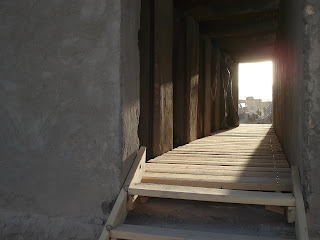
But nature does take its course and in the middle of the desert with nearly 400 US marines, you simply cannot have everyone defacting wherever they wanted, as sickness would spread fast. Portaloos would be useless as they cannot be emptied and the proverbial taken away and disposed off.
Enter plastic bag Number 2 the “Wag Bag”. WAG naturally is a military acronym for “Waste Alleviating Gel”. Porcelain is a distant memory and a plastic frame greets you as you enter the little room. Open your Wag bag Kit take out of the plastic bag from inside the plastic bag and fit over the frame. Let nature take care of itself, sans fluid.
Take out the plastic WAG and seal it in another zip loc plastic bag and walk up to the drums and deposit the WAG in the drum.

Perhaps one of the least glamorous job for any Private is being assigned to burn the bags, but every evening you would see a couple of Marines pour diesel in the bins and setting fire to the Wag Bags. Not exactly back breaking hard work but a key function on the frontline.
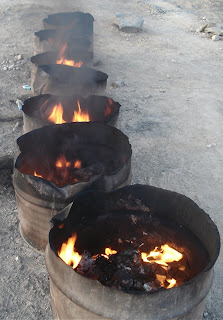
The guys would sit there, talk and occasionally stand up grab the shit stick and poke the bags to complete the “Cycle of Plastic”.
Death and Wag Bags, two facts of life in the War on Terror in the Helmand Desert
Read More →Death and Taxes , plus Wag Bags
Death and Taxes are the two things in life that we can be sure of, and well there is a natural third. What goes in most go out, and at FOB (Forward Operating Base), in Now Zad Afghanistan, what starts in plastic ends in plastic.
MRE rations come in brown plastic bags, with yet more plastic bags inside that then contain more plastic wrapping different items from a spoon to the salt. The thing about MRE’s is that is like grown up’s baby food, sometimes there is consistency more often not the meal resembles what’s on the label, just do not read the ingredients, to keep meals from spoiling no chemical compound is forgotten.
Eating on this trip is a challenge; not because the meals are bland and monotonous, but the heat makes your appetite just disappear. It is hard enough to keep drinking enough water to stay hydrated and alive.
But nature does take its course and in the middle of the desert with nearly 400 US marines, you simply cannot have everyone defacting wherever they wanted, as sickness would spread fast. Portaloos would be useless as they cannot be emptied and the proverbial taken away and disposed off.
Enter plastic bag Number 2 the “Wag Bag”. WAG naturally is a military acronym for “Waste Alleviating Gel”. Porcelain is a distant memory and a plastic frame greets you as you enter the little room. Open your Wag bag Kit take out of the plastic bag from inside the plastic bag and fit over the frame. Let nature take care of itself, sans fluid.
Take out the plastic WAG and seal it in another zip loc plastic bag and walk up to the drums and deposit the WAG in the drum.
Perhaps one of the least glamorous job for any Private is being assigned to burn the bags, but every evening you would see a couple of Marines pour diesel in the bins and setting fire to the Wag Bags. Not exactly back breaking hard work but a key function on the frontline.
The guys would sit there, talk and occasionally stand up grab the shit stick and poke the bags to complete the “Cycle of Plastic”.
Death and Wag Bags, two facts of life in the War on Terror in the Helmand Desert
Read More →Around 8 Hours
Getting to the Frontline in Afghanistan is not easy; you take what ever you can, whenever you can. Competition amongst all Media agencies whether TV, Print, Stills or Radio is intense. We all want to get there before the others and get the preverbial scoop.
Sitting in the tent at Camp Leatherneck in Helmand Province, South Afghanistan, Correspondent Greg Palkot and I where grouped with 3 members of Associated Press and Radio Reporter from NPR. We had already waited at Kabul Airport for 37 hours trying to get ahead of the rest of the pack only to have had two flights cancelled and had become known as the “Kabul Two” for being stranded there and waiting.
To get forward the usual method is by helicopter, inevitably at some insane hour of the morning like 2am, and without doubt we are generally classified as “Space A” passengers. Meaning that if Space is Available you can get a seat on the bird, if not you are bumped to the next flight, which can be 24 hours later or more.
To get to our FOB (Forward Operating Base) at Now Zad, in Northern Helmand we were told that we might have chance in the next 36 hours, but as we saw other media going to other areas returning to the tent we shared at Camp Leather neck coming back after being bounced time and time again. Greg had an idea, if you cannot fly then what about driving up in a Convoy, the FOB is only sixty miles North of Leatherneck.
Without letting on we managed to find a Supply Convoy heading out that Afternoon (August 6th 2009), a forty one-vehicle log train driving through the “Desert of Death” as the Helmand Desert is called for being one of the most inhospitable places on the planet, carrying everything from ammunition to food and water. It would stretch over 2 km’s long.
It should take no longer than 8 hours was the word from the PAO (Public Affairs Officer) organizing logistics. That’s do able, I agreed with Greg, anything beats sitting around and waiting. And we could also do a story on the Convoy itself.
Cutting the number of bags we were traveling with to seven (Five equipment and Two personal) we were taken to the Convoy staging area and introduced to the guys who were to become relatively close friends in the confines of the MRAP we were to travel in.
Sgt James Mitchell or (Terrets) was the Vehicle Commander, Lance Corporal Chris Lance (Old Man) driving the beast, sharing the gun of the roof were Lance Corporal Raul Lustre from California and (Dr J) Lance Corporal Jaron Hester.
They simply laughed when I asked about the 8 hour drive, “Man the record for this trip is 17 hours, the longest trip 53 hours” replied the Sarge. Something you should know is that we expect to get hit by IED bombs, we have done this convoy four times and only once have we not been hit. “Welcome to the most dangerous trip you can do in the world”. Seatbelts not required but you must wear your body armor at all times, these vehicles are designed to withstand IED blasts but we hoped not to test the theory”.
The Chaplain for the HQ, came and lead the prayers for all traveling, and we loaded up closed the thick armored door behind us, together with 131 Marines we began the trip.
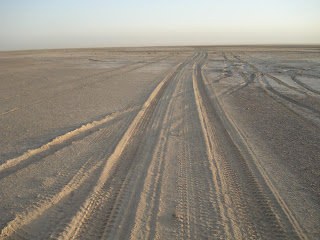
There would be no road traveled we where to make our own new road across the Desert to avoid IED’s as is the normal practice here now. A bulldozer scrapes a path and everyone stays in tracks ahead of them.
“Old Man” finally touched the gas pedal at 3:40pm, it took forty minutes to actually get out of the Base and past the final strand of Razor Wire less than a mile and the sixty to go did not start till the gate.
We approached the main East West Highway and the only two hundred yards of road we would be on. It was considered safe as the Base had “eyes” on this stretch. Greg and I had actually driven on this road back in May 2001, when the Taliban were in power, we had simply hired a couple of taxi’s and driven from Heart to Kandahar, with no security or for that matter concerns about safety.
Before the second hour was up we stopped, not for an IED but simply a vehicle had broken down, not one but three trucks were in trouble. Thirty minutes later we rolled forward 50 meters and stopped again a fourth vehicle now had a problem, then a fifth.
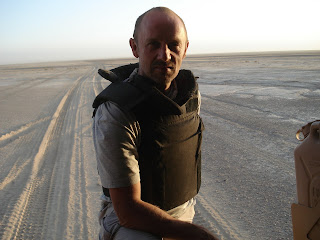
As the last light faded, we had covered less than 300m in two hours. I started to question our decision to convoy and began to plot just how long this could take, had we made a bad choice.
5 hours after leaving the Base and we could still see the lights clearly, things were not going well and there was no turning back, only the tracks of the vehicle ahead in the sand.
Just before Midnight the convoy halted to refuel, the convoy travels with its own gas tanker. And the lights of the Base were still on the horizon, nearly eight hours after leaving
There is only so much room and so many positions you can try to get comfortable in, imaging two economy class seats facing each other with even less legroom than a cheap charter plane crams in, and that is your world, your body armor plates dig into your back making sleep near impossible, two minutes here five minutes there, the next bump wakes you as we tumble into each other. At times it became a Pilates Stretching class as you try to find that extra inch to stretch out a cramping muscle.
Lance Corporal Lustre, 19 from California, joined the Marines not because of 9/11 he vaguely remembers being at school and watching the aftermath on TV in the hall, but because he wanted to “Make a difference”. President Reagan once commented, “Some people spend an entire lifetime wondering if they had made a difference, Marines don’t have that problem”. And that’s why he joined, his Girlfriend and Parents are not excited about him being here in Afghanistan, however was he excited about being here, he answered “Yes”.
We were yet to enter what the Marines called “Hell Pass” and the beginning of Taliban controlled territory, over the radio you could hear muffled messages from the Intelligence guys warning of trouble looming.
Twelve hours into the trip, we had stopped asking how far or how much further, first light was coming, we had not eaten since Lunch the day before, it is too hard to digest when every 15 seconds or so you go over another bone jolting bump. Conversations in the vehicle became less and less, exhaustion was setting in. Boredom a fact of life as was my body armor chaffing my skin red.
We had requested to move up in the convoy after dawn as there is only so much video you can shoot from the back. And after 16 hours we bade farewell to the guys and moved into “Vic 2” the second vehicle after the clearance team in the convoy.
I could now stand up through the exit hatch at the back and see why we had taken so long to get such little distance. We were know approaching the most feared part of the trip for the convoy the “Wadi Zone”. Dried river and creek beds where the Taliban favored planting IED’s the previous attacks had all taken part in this area.
The armored bulldozer with almost trepidation descended into the first of the Wadi’s plowing a road for us to follow. The theory being that if there is an IED then the front scoop will take the blast. I tried to imagine just what must being going through the drivers mind as you plow ahead and expect to hit a bomb, and then you think the person driving this suicide plough is probably only 19 years old and not yet legal to drink alcohol in States back home.
We crossed without incident and I expected that tension would ease up in the vehicle, but as the Sarge said we were still to cross “IED Wadi” the one we had traversed was simply a tributary of the one they all feared.
Before crossing two guys from Explosives Team swept by hand “IED Wadi” bed with metal detectors, an almost futile gesture now as the Taliban no longer use any metal parts in their homemade bombs to avoid detection. Once they gave the all clear the bulldozer again descended the bank and made a clear path.
Our destination was getting close but 4 more Wadi’s had to be cleared, 18 hours had passed and the lookouts were nervous, children carrying yellow plastic jugs were noted, shepherds with flocks of goats were potential Taliban lookouts. Anyone moving at more than a slow shuffle in the late morning heat haze was a suspect.
The final miles had become a struggle against exhaustion and nervous tension. Locked in a metal box the air conditioning battled the extremes of the approaching noonday sun. But at least we were moving closer by the hour.
We entered the safe confines of FOB Now Zad after twenty hours; given the delays at the start the mood of the Marines as we all climbed out was that of relief. For Greg and I we looked at each other and wondered just what planet we were on. Moon dust or “Afghan Snow” a fine powder was six inches deep and the temperature was in the 120’s degree Fahrenheit. We had beaten the competition up, and had a good story in the can as we say.
The other Press flew up that night; it took them 18 minutes in a helicopter to cover the same distance it had taken us twenty hours to travel.
When I next buy a lottery ticket, I am going to use the numbers of hours that were predicted, discussed and joked about how long it would take to cover the Desert of Death Convoy.
Read More →Around 8 Hours
Getting to the Frontline in Afghanistan is not easy; you take what ever you can, whenever you can. Competition amongst all Media agencies whether TV, Print, Stills or Radio is intense. We all want to get there before the others and get the preverbial scoop.
Sitting in the tent at Camp Leatherneck in Helmand Province, South Afghanistan, Correspondent Greg Palkot and I where grouped with 3 members of Associated Press and Radio Reporter from NPR. We had already waited at Kabul Airport for 37 hours trying to get ahead of the rest of the pack only to have had two flights cancelled and had become known as the “Kabul Two” for being stranded there and waiting.
To get forward the usual method is by helicopter, inevitably at some insane hour of the morning like 2am, and without doubt we are generally classified as “Space A” passengers. Meaning that if Space is Available you can get a seat on the bird, if not you are bumped to the next flight, which can be 24 hours later or more.
To get to our FOB (Forward Operating Base) at Now Zad, in Northern Helmand we were told that we might have chance in the next 36 hours, but as we saw other media going to other areas returning to the tent we shared at Camp Leather neck coming back after being bounced time and time again. Greg had an idea, if you cannot fly then what about driving up in a Convoy, the FOB is only sixty miles North of Leatherneck.
Without letting on we managed to find a Supply Convoy heading out that Afternoon (August 6th 2009), a forty one-vehicle log train driving through the “Desert of Death” as the Helmand Desert is called for being one of the most inhospitable places on the planet, carrying everything from ammunition to food and water. It would stretch over 2 km’s long.
It should take no longer than 8 hours was the word from the PAO (Public Affairs Officer) organizing logistics. That’s do able, I agreed with Greg, anything beats sitting around and waiting. And we could also do a story on the Convoy itself.
Cutting the number of bags we were traveling with to seven (Five equipment and Two personal) we were taken to the Convoy staging area and introduced to the guys who were to become relatively close friends in the confines of the MRAP we were to travel in.
Sgt James Mitchell or (Terrets) was the Vehicle Commander, Lance Corporal Chris Lance (Old Man) driving the beast, sharing the gun of the roof were Lance Corporal Raul Lustre from California and (Dr J) Lance Corporal Jaron Hester.
They simply laughed when I asked about the 8 hour drive, “Man the record for this trip is 17 hours, the longest trip 53 hours” replied the Sarge. Something you should know is that we expect to get hit by IED bombs, we have done this convoy four times and only once have we not been hit. “Welcome to the most dangerous trip you can do in the world”. Seatbelts not required but you must wear your body armor at all times, these vehicles are designed to withstand IED blasts but we hoped not to test the theory”.
The Chaplain for the HQ, came and lead the prayers for all traveling, and we loaded up closed the thick armored door behind us, together with 131 Marines we began the trip.
There would be no road traveled we where to make our own new road across the Desert to avoid IED’s as is the normal practice here now. A bulldozer scrapes a path and everyone stays in tracks ahead of them.
“Old Man” finally touched the gas pedal at 3:40pm, it took forty minutes to actually get out of the Base and past the final strand of Razor Wire less than a mile and the sixty to go did not start till the gate.
We approached the main East West Highway and the only two hundred yards of road we would be on. It was considered safe as the Base had “eyes” on this stretch. Greg and I had actually driven on this road back in May 2001, when the Taliban were in power, we had simply hired a couple of taxi’s and driven from Heart to Kandahar, with no security or for that matter concerns about safety.
Before the second hour was up we stopped, not for an IED but simply a vehicle had broken down, not one but three trucks were in trouble. Thirty minutes later we rolled forward 50 meters and stopped again a fourth vehicle now had a problem, then a fifth.
As the last light faded, we had covered less than 300m in two hours. I started to question our decision to convoy and began to plot just how long this could take, had we made a bad choice.
5 hours after leaving the Base and we could still see the lights clearly, things were not going well and there was no turning back, only the tracks of the vehicle ahead in the sand.
Just before Midnight the convoy halted to refuel, the convoy travels with its own gas tanker. And the lights of the Base were still on the horizon, nearly eight hours after leaving
There is only so much room and so many positions you can try to get comfortable in, imaging two economy class seats facing each other with even less legroom than a cheap charter plane crams in, and that is your world, your body armor plates dig into your back making sleep near impossible, two minutes here five minutes there, the next bump wakes you as we tumble into each other. At times it became a Pilates Stretching class as you try to find that extra inch to stretch out a cramping muscle.
Lance Corporal Lustre, 19 from California, joined the Marines not because of 9/11 he vaguely remembers being at school and watching the aftermath on TV in the hall, but because he wanted to “Make a difference”. President Reagan once commented, “Some people spend an entire lifetime wondering if they had made a difference, Marines don’t have that problem”. And that’s why he joined, his Girlfriend and Parents are not excited about him being here in Afghanistan, however was he excited about being here, he answered “Yes”.
We were yet to enter what the Marines called “Hell Pass” and the beginning of Taliban controlled territory, over the radio you could hear muffled messages from the Intelligence guys warning of trouble looming.
Twelve hours into the trip, we had stopped asking how far or how much further, first light was coming, we had not eaten since Lunch the day before, it is too hard to digest when every 15 seconds or so you go over another bone jolting bump. Conversations in the vehicle became less and less, exhaustion was setting in. Boredom a fact of life as was my body armor chaffing my skin red.
We had requested to move up in the convoy after dawn as there is only so much video you can shoot from the back. And after 16 hours we bade farewell to the guys and moved into “Vic 2” the second vehicle after the clearance team in the convoy.
I could now stand up through the exit hatch at the back and see why we had taken so long to get such little distance. We were know approaching the most feared part of the trip for the convoy the “Wadi Zone”. Dried river and creek beds where the Taliban favored planting IED’s the previous attacks had all taken part in this area.
The armored bulldozer with almost trepidation descended into the first of the Wadi’s plowing a road for us to follow. The theory being that if there is an IED then the front scoop will take the blast. I tried to imagine just what must being going through the drivers mind as you plow ahead and expect to hit a bomb, and then you think the person driving this suicide plough is probably only 19 years old and not yet legal to drink alcohol in States back home.
We crossed without incident and I expected that tension would ease up in the vehicle, but as the Sarge said we were still to cross “IED Wadi” the one we had traversed was simply a tributary of the one they all feared.
Before crossing two guys from Explosives Team swept by hand “IED Wadi” bed with metal detectors, an almost futile gesture now as the Taliban no longer use any metal parts in their homemade bombs to avoid detection. Once they gave the all clear the bulldozer again descended the bank and made a clear path.
Our destination was getting close but 4 more Wadi’s had to be cleared, 18 hours had passed and the lookouts were nervous, children carrying yellow plastic jugs were noted, shepherds with flocks of goats were potential Taliban lookouts. Anyone moving at more than a slow shuffle in the late morning heat haze was a suspect.
The final miles had become a struggle against exhaustion and nervous tension. Locked in a metal box the air conditioning battled the extremes of the approaching noonday sun. But at least we were moving closer by the hour.
We entered the safe confines of FOB Now Zad after twenty hours; given the delays at the start the mood of the Marines as we all climbed out was that of relief. For Greg and I we looked at each other and wondered just what planet we were on. Moon dust or “Afghan Snow” a fine powder was six inches deep and the temperature was in the 120’s degree Fahrenheit. We had beaten the competition up, and had a good story in the can as we say.
The other Press flew up that night; it took them 18 minutes in a helicopter to cover the same distance it had taken us twenty hours to travel.
When I next buy a lottery ticket, I am going to use the numbers of hours that were predicted, discussed and joked about how long it would take to cover the Desert of Death Convoy.
Read More →WINNERS in the b-roll.net COMMERCIAL Contest
Congratulations to our two winners in the latest b-roll.net CONTEST. This entertaining contest had a simple concept – write and produce a :30-1:00 commercial for b-roll.net. The videos were posted, and the you voted.
AND THE WINNER IS…
Return From Embed
Operation Eastern Resolve 2
Now Zad / Dehanna – Helmand Afghanistan
August 2009
The media calls it “Bang Bang or Action”; the Marines call it “Kinetic”. What it means is that everyone wants War. It is not unusual to be sitting around on a FOB, (Forward Operating Base) and hear a 19-year-old Marine say casually as if talking football that he wants to “Kill someone today”. The officers sitting around do not politically correct him, more than likely they will nod their heads and smile, for that is what Marines on the frontline are trained to do. War is about killing and defeating an enemy.
Now that I am back in the relative safety of Camp Leatherneck in Helmand after nine days being embedded in the North of the Province, reflections become like a stone thrown into a pond the initial splash causes the ripples to extend out and memories are like that, there is no central point but just expanding thoughts on what I have experienced in the last days.
The first thing that strikes you here is the heat, you hear about it, read about it but to live it, is like taking your soul and slowly stripping it down to the point where you simply try to function. A cold bottle of water is something you actually start to dream of, the reality is that you simply accept that you are going to have yet another bottle of hot bath water. I eventually resorted to wetting my sock and putting the bottle in the wet sock and by the process of evaporation the bottle would cool down a few degrees, and that was as good as it would get. One day I drank 11 liters of water and yet only urinated less than half a teacup of dark treacle, drinking water here is not a trendy good for you fad as recommended by a health agency, but a fact of trying to stay alive. Talk with anyone on the frontline and the conversation inevitably turns to urine, colors and amounts are discussed with strangers, stand a piss tube (a plastic PVC pipe into the ground, serves as a urinal, with a piece of gauze over to stop the flies and wasps going down it) and you compare amounts discharged.
This entry will run over a few entries as the story is long and has like a book many chapters, but there is no end, for the war here has no end. More will die, more will be injured.
The “Read Board” of 2/3 Marines newsletter has a 10×8 photo of a colleague who lost both his legs in an IED (Improvised Explosive Device) explosion with two prosthetic limbs learning how to walk again, he looked no older than 20.
They have an expression at the frontline called “River City” whereby in the event of a fellow Marine being killed or injured then all communication with the outside world is severed for them, no phone calls, no Internet. The next of kin must first learn of the casualty from a knock on their front door from an officer and normally a chaplain. When you prepare for any event the first details you give in order are; Surname, Christian name, last four digits of your Social Security Blood type and Religious Preference. The later reflects who will knock on your next of kin’s door.
The War in Afghanistan has become the second longest in US history, after Vietnam. There is no end date, no timetable, just a circle of mistakes and bad policy decisions by leaders, both Political and Military. The average age of an Infantry Marine fighting is between 19 and 20, when 9/11 happened they were 11 or 12 years old not even in High School. Most of the Marines I talked too on this trip cannot remember or recollect where they were when the World Trade Center in New York was attacked.
As most of them say, “ I just want to get some “ action.
Read More →Return From Embed
Operation Eastern Resolve 2
Now Zad / Dehanna – Helmand Afghanistan
August 2009
The media calls it “Bang Bang or Action”; the Marines call it “Kinetic”. What it means is that everyone wants War. It is not unusual to be sitting around on a FOB, (Forward Operating Base) and hear a 19-year-old Marine say casually as if talking football that he wants to “Kill someone today”. The officers sitting around do not politically correct him, more than likely they will nod their heads and smile, for that is what Marines on the frontline are trained to do. War is about killing and defeating an enemy.
Now that I am back in the relative safety of Camp Leatherneck in Helmand after nine days being embedded in the North of the Province, reflections become like a stone thrown into a pond the initial splash causes the ripples to extend out and memories are like that, there is no central point but just expanding thoughts on what I have experienced in the last days.
The first thing that strikes you here is the heat, you hear about it, read about it but to live it, is like taking your soul and slowly stripping it down to the point where you simply try to function. A cold bottle of water is something you actually start to dream of, the reality is that you simply accept that you are going to have yet another bottle of hot bath water. I eventually resorted to wetting my sock and putting the bottle in the wet sock and by the process of evaporation the bottle would cool down a few degrees, and that was as good as it would get. One day I drank 11 liters of water and yet only urinated less than half a teacup of dark treacle, drinking water here is not a trendy good for you fad as recommended by a health agency, but a fact of trying to stay alive. Talk with anyone on the frontline and the conversation inevitably turns to urine, colors and amounts are discussed with strangers, stand a piss tube (a plastic PVC pipe into the ground, serves as a urinal, with a piece of gauze over to stop the flies and wasps going down it) and you compare amounts discharged.
This entry will run over a few entries as the story is long and has like a book many chapters, but there is no end, for the war here has no end. More will die, more will be injured.
The “Read Board” of 2/3 Marines newsletter has a 10×8 photo of a colleague who lost both his legs in an IED (Improvised Explosive Device) explosion with two prosthetic limbs learning how to walk again, he looked no older than 20.
They have an expression at the frontline called “River City” whereby in the event of a fellow Marine being killed or injured then all communication with the outside world is severed for them, no phone calls, no Internet. The next of kin must first learn of the casualty from a knock on their front door from an officer and normally a chaplain. When you prepare for any event the first details you give in order are; Surname, Christian name, last four digits of your Social Security Blood type and Religious Preference. The later reflects who will knock on your next of kin’s door.
The War in Afghanistan has become the second longest in US history, after Vietnam. There is no end date, no timetable, just a circle of mistakes and bad policy decisions by leaders, both Political and Military. The average age of an Infantry Marine fighting is between 19 and 20, when 9/11 happened they were 11 or 12 years old not even in High School. Most of the Marines I talked too on this trip cannot remember or recollect where they were when the World Trade Center in New York was attacked.
As most of them say, “ I just want to get some “ action.
Read More →